


Backflow Prevention Testing Requirements for Knoxville Businesses
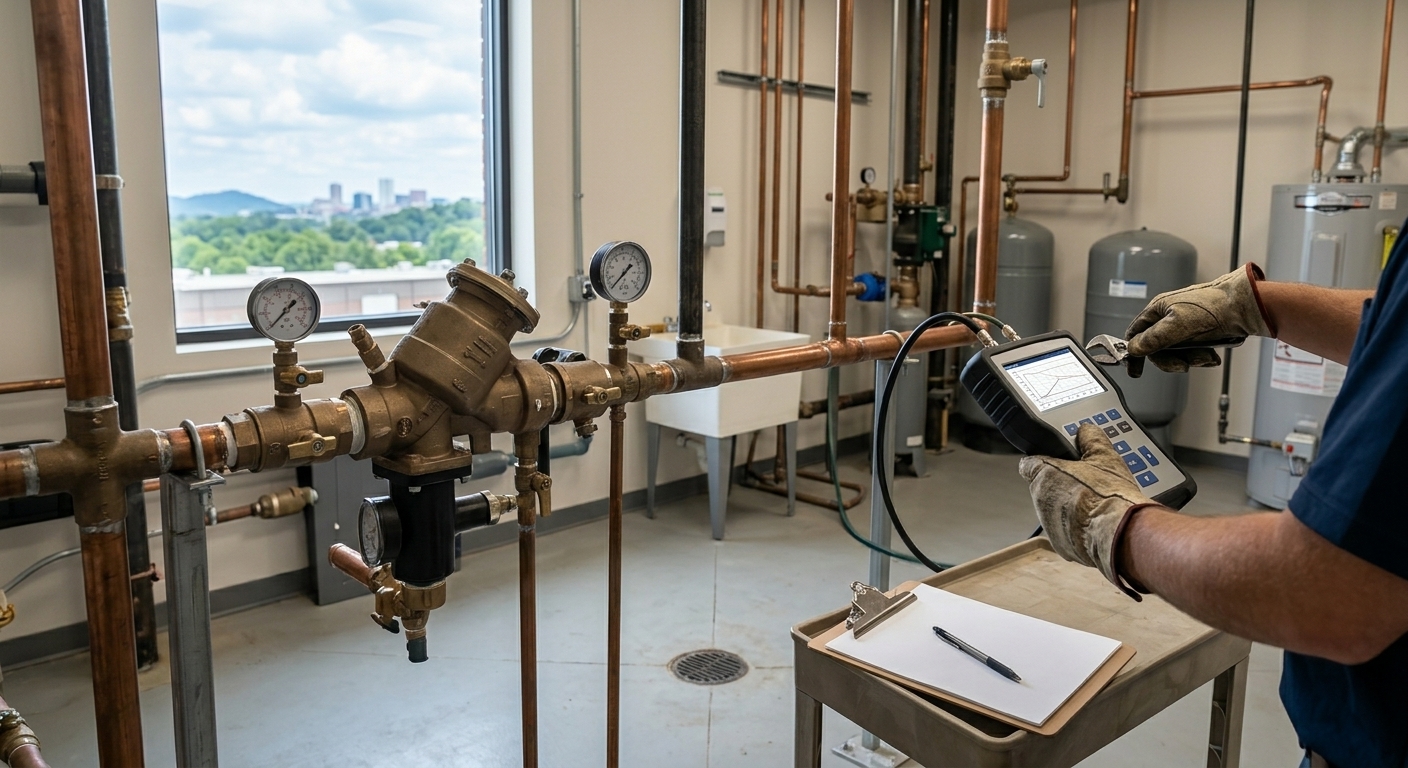
Clean, safe municipal drinking water is a fundamental requirement for commercial operations across Knoxville, Tennessee. From bustling restaurants on Market Square and medical facilities in Bearden to manufacturing plants along Interstate 40 and multi-family residential complexes in West Knoxville, commercial properties connect directly to public water mains. However, because commercial plumbing networks often interface with industrial chemicals, boilers, irrigation systems, dishwashers, and medical equipment, they present a constant potential risk of backflow contamination.
Backflow occurs when pressure changes in a plumbing system reverse the natural flow of water, allowing non-potable liquids, chemicals, or biological contaminants to siphon backward into the public drinking water supply. To protect public health, the State of Tennessee and local water purveyors enforce strict mandates requiring commercial facilities to install, maintain, and annually test certified backflow prevention assemblies.
Failing to meet annual backflow testing requirements can lead to severe operational disruptions, including hefty municipal fines, health department violations, and the immediate shutoff of water service. This comprehensive guide outlines backflow mechanics, regulatory compliance standards, testing procedures, and best practices for Knoxville business owners and facility managers.
1. Understanding Backflow: Hydraulic Physics and Health Hazards
To grasp why regulatory authorities enforce strict backflow testing requirements, facility managers must understand the hydraulic forces that cause water flow reversal. Under normal operating conditions, municipal water mains deliver clean water to commercial buildings under continuous positive pressure, typically between 50 and 80 PSI. This pressure forces water to flow in one direction: from the purveyor's main distribution pipe into the customer's private plumbing system.
When hydraulic equilibrium is disrupted, backflow occurs through one of two mechanisms: backsiphonage or backpressure.
Backsiphonage
Backsiphonage happens when a sudden, drastic drop in municipal water main pressure creates a partial vacuum or negative pressure inside the distribution line. This vacuum pulls water backward out of private commercial plumbing systems into the public main, much like liquid drawn through a drinking straw.
Common triggers for backsiphonage in Knoxville include:
- A major municipal water main break along a primary roadway.
- Heavy water draw by the Knoxville Fire Department during emergency firefighting operations.
- Routine high-volume main flushing by local utility districts.
- Sudden pump failures at municipal booster stations.
If an open cross-connection exists during a backsiphonage event, non-potable water, toxic chemicals, or stagnant fluids are sucked directly into the municipal drinking water grid.
Backpressure
Backpressure occurs when the pressure generated within a commercial facility's private plumbing system exceeds the incoming pressure supplied by the municipal water main. When downstream pressure surpasses supply pressure, non-potable fluids are forced backward through the water meter and into the public main.
Common causes of backpressure in commercial facilities include:
- High-pressure boiler feed pumps and thermal expansion units.
- Elevated storage tanks and recirculating booster pumps.
- Pressurized chemical mixing tanks and industrial wash systems.
- Recirculating cooling towers and HVAC heat exchangers.
Managing commercial water infrastructure requires a clear understanding of system dynamics. Reviewing a comprehensive guide on understanding commercial plumbing provides essential insight into how backflow prevention integrates with overall building supply networks, waste lines, and water heating systems.
2. Cross-Connections in Commercial Facilities
A cross-connection is any physical link or arrangement between a potable water system and any source of non-potable liquid, gas, or solid contaminant. In commercial environments, cross-connections are frequently necessary for daily operations, but they must be isolated using approved backflow prevention assemblies.
High-Hazard Commercial Applications
Different commercial property types present varying degrees of risk to the public water supply:
- Restaurants and Food Service Operations: Commercial kitchens feature carbonators for soda fountains, post-mix beverage machines, commercial dishwashers, grease trap flushes, and steam tables. Carbonated water coming into contact with copper supply lines creates toxic copper carbonate, which poses an immediate health hazard if siphoned back into supply lines.
- Medical Facilities and Laboratories: Hospitals, dental clinics, veterinary practices, and research labs utilize equipment connected directly to water supply lines, including autoclaves, darkroom processors, aspirators, dialyzers, and specimen basins.
- Manufacturing and Industrial Plants: Facilities involved in chemical mixing, metal plating, printing, or textile processing use water supply lines to blend toxic chemicals, dyes, solvents, and heavy metals.
- Commercial Real Estate and Multi-Story Buildings: High-rise office towers, apartment complexes, and shopping centers use large boilers, chillers, fire sprinkler systems, and elevated water storage tanks that utilize chemical rust inhibitors and anti-freeze compounds.
- Commercial Irrigation and Agriculture: Landscape irrigation networks feature underground sprinkler heads exposed to soil fertilizers, animal waste, weed killers, and stagnant groundwater.
Without proper isolation, these cross-connections create dangerous pathways for toxic substances to migrate into drinking water. Exploring why you need a professional plumbing inspection outlines how certified plumbers identify unrecognized cross-connections and verify that safety valves operate correctly.
3. Types of Backflow Prevention Assemblies Required in Knoxville
Not all backflow prevention devices offer the same level of protection. Regulatory agencies categorize backflow preventers based on the degree of hazard present in the commercial facility.
Reduced Pressure Zone Assembly (RPZ or RP)
The Reduced Pressure Zone assembly offers the highest level of protection available in mechanical backflow prevention. An RPZ valve consists of two independently acting check valves separated by a hydraulically operated differential relief valve located between them.
- How It Works: If either check valve leaks or if backpressure occurs, the internal relief valve automatically opens and discharges contaminated water out to the atmosphere, breaking the hydraulic link and preventing backward flow.
- Required Applications: Mandatory for high-hazard commercial applications, including chemical plants, car washes, medical clinics, mortuaries, commercial kitchens with beverage carbonators, and irrigation systems with chemical injection.
- Installation Mandates: RPZ assemblies must be installed above ground, in a temperature-controlled enclosure or indoor mechanical room, with adequate drainage to handle full relief valve discharge. They must never be installed in underground pits or locations subject to flooding.
Double Check Valve Assembly (DCVA or DC)
A Double Check Valve assembly consists of two independently operating, spring-loaded check valves enclosed within a single valve body, flanked by shutoff valves and test cocks.
- How It Works: The check valves open under normal forward pressure. If pressure drops or reverses, the spring-loaded checks snap shut, preventing water from flowing backward.
- Required Applications: Used exclusively for medium to low-hazard applications where contaminants do not pose a toxic health threat, such as fire sprinkler systems without chemical additives and standard commercial building main lines.
- Installation Mandates: DCVA units can be installed indoors, in accessible mechanical closets, or in outdoor utility vaults equipped with proper drainage.
Pressure Vacuum Breaker (PVB)
A Pressure Vacuum Breaker contains an independently operating spring-loaded check valve and an air-inlet valve. It is designed specifically to prevent backsiphonage on continuous-pressure lines.
- Required Applications: Commonly installed on commercial lawn irrigation systems, outdoor hose bibb manifolds, and industrial washdown stations.
- Installation Mandates: PVB units must be installed outdoors or in dedicated drainage areas at least 12 inches higher than the highest downstream outlet or sprinkler head.
Facility managers seeking specialized protection can consult certified technicians for commercial backflow prevention services to ensure the correct assembly type is specified, installed, and certified according to local code.
4. Knoxville Utility Purveyors and Regulatory Compliance Standards
Commercial backflow prevention in Knox County operates under strict regulatory oversight from both state and local authorities.
Regulatory Oversight Framework
Backflow compliance is mandated at multiple government levels:
- Tennessee Department of Environment and Conservation (TDEC): TDEC Rule 0400-45-01-.14 mandates that all public water systems in Tennessee enforce active Cross-Connection Control Programs to safeguard public drinking water.
- Local Municipal Water Purveyors: Specific enforcement falls under the utility purveyor serving your property address. Key purveyors across Knox County include Knoxville Utilities Board (KUB), First Utility District (FUD), West Knox Utility District (WKUD), and Lenoir City Utilities Board (LCUB).
- International Plumbing Code (IPC): Local building codes adopted by the City of Knoxville Plans Review and Inspections and Knox County Codes Administration dictate specific piping, venting, and drainage requirements for backflow installations.
Annual Testing Requirements
Tennessee law mandates that every commercial backflow prevention assembly must be tested by a TDEC-certified tester:
- Upon Initial Installation: Immediately after a new device is installed or an existing service line is modified.
- Annually: Exactly once every 12 months on a recurring schedule established by the water utility.
- Following Any Repair: Immediately after an assembly is serviced, rebuilt, or relocated.
Notice of Non-Compliance and Service Disconnection
Water purveyors send official testing notices to commercial property owners 30 to 60 days before their annual compliance deadline. If a business fails to submit a certified test report by the specified due date, the utility issues a formal notice of non-compliance.
Continued failure to comply results in severe consequences:
- Termination of Water Service: The utility purveyor will shut off the main water service valve at the street meter box to isolate the property, forcing the business to close temporarily.
- Civil Penalties and Fines: Municipal purveyors and TDEC can assess daily financial penalties for willful non-compliance.
- Health Department Invalidation: Food service establishments, hotels, and medical clinics will lose their operating permits if water service is terminated or backflow certification lapses.
Maintaining a clear timeline for facility checkups ensures regulatory deadlines are never missed. Reviewing guidelines on how often should you inspect your plumbing helps building managers schedule annual backflow testing alongside routine pipe and fixture audits.
5. The Step-by-Step Backflow Testing Process
Understanding what happens during a certified backflow test allows facility managers to prepare their operations and minimize business disruption.
Step 1: On-Site Arrival & Water Shutoff Notification
                  │
                  ▼
Step 2: Visual Inspection of Valve Body & Seals
                  │
                  ▼
Step 3: Connect Calibrated Differential Pressure Gauge
                  │
                  ▼
Step 4: Measure Check Valve 1 & 2 Tight-Seating Pressure
                  │
                  ▼
Step 5: Test Relief Valve Opening Differential (RPZ Units)
                  │
                  ▼
Step 6: Record Data & Submit Compliance Report to Purveyor
Step 1: Pre-Test Coordination and Inspection
The certified tester arrives on site, locates the backflow assembly, and notifies facility staff that water service will be temporarily interrupted. The technician performs a visual inspection to check for physical damage, heavy corrosion, leaking shutoff handles, or unauthorized bypass piping.
Step 2: Gauge Connection and Line Flushing
The tester connects a specialized, calibrated differential pressure gauge to the assembly's test cocks using flexible high-pressure hoses. Before reading pressures, the technician flushes the test cocks to clear rust, sand, or mineral debris that could clog the test gauge.
Step 3: Mechanical Pressure Testing
The tester manipulates control valves on the test gauge to measure specific pressure drops across internal components:
- First Check Valve Test: The tester isolates water pressure and verifies that the first check valve holds tightly against backpressure, maintaining a minimum differential pressure (typically 5.0 PSI for RPZ valves).
- Second Check Valve Test: The tester verifies that the second check valve seals completely, preventing any reverse flow.
- Relief Valve Test (RPZ Only): The tester gradually reduces pressure between the check valves to verify that the differential relief valve opens automatically before pressure across the first check drops below 2.0 PSI.
Step 4: Documentation and Official Certification
If all internal components pass pressure tolerances, the technician fills out official cross-connection test report forms. The report details:
- Property owner information and physical service address.
- Water utility account number and meter serial number.
- Backflow device manufacturer, model, size, and serial number.
- Exact differential pressure readings recorded during testing.
- TDEC tester certification number and calibration date of the test kit.
The completed report is submitted electronically to the appropriate utility provider (such as KUB or FUD) to update the property's compliance records.
What Happens If an Assembly Fails Testing?
If a backflow assembly fails inspection due to a leaking check valve or stuck relief mechanism, it must be repaired immediately. Modern commercial backflow valves feature modular internal components, allowing certified technicians to replace worn rubber seals, stainless steel springs, or check discs on site without replacing the entire valve body. Once repaired, the assembly is re-tested and certified immediately.
Keeping wastewater lines clear during backflow maintenance prevents floor drain overflows in mechanical rooms. Utilizing expert professional drain line repair services ensures mechanical room floor drains handle emergency relief discharges smoothly.
6. How to Select a Certified Backflow Contractor in Knoxville
Backflow prevention testing is a specialized field that requires dedicated training, state credentials, and calibrated equipment. When selecting a commercial plumbing partner, verify the following qualifications:
- TDEC Cross-Connection Control Tester Certification: Ensure the technician performing the test holds an active certification card issued by the State of Tennessee.
- Calibrated Testing Equipment: State regulations mandate that backflow test gauges must be tested and recalibrated annually by a certified laboratory to guarantee precision.
- Turnkey Repair and Replacement Capabilities: Choose a full-service plumbing contractor capable of performing immediate repairs or full valve replacements if a device fails testing, eliminating the need to hire multiple contractors.
- Direct Electronic Purveyor Reporting: Select a contractor who submits compliance documentation directly to local utility purveyors on your behalf, ensuring your certification is recorded promptly.
Frequently Asked Questions
What is the difference between a backflow preventer and a backwater valve?
A backflow preventer is installed on drinking water supply lines to stop non-potable liquids or chemicals from siphoning backward into the public drinking water grid. A backwater valve is installed on sewer lines to prevent municipal wastewater from backing up into a building's lower-level floor drains during heavy rainfall.
How often do Knoxville businesses need to test their backflow preventers?
Tennessee state law and local utility purveyors mandate that every commercial backflow prevention assembly must be tested and certified by a state-certified tester at least once every 12 months, as well as immediately following new installation, relocation, or repair.
Which water utility purveyors oversee backflow compliance in Knox County?
Depending on your exact commercial property location, compliance is governed by Knoxville Utilities Board (KUB), First Utility District (FUD), West Knox Utility District (WKUD), or Lenoir City Utilities Board (LCUB). Each purveyor enforces strict testing schedules and reporting protocols.
What happens if my business misses its annual backflow testing deadline?
Missing your compliance deadline results in an official notice of non-compliance. Continued failure to submit certified test reports will lead to municipal fines, health department violations, and the immediate termination of main water service at the street meter.
How long does a standard commercial backflow test take?
A standard backflow test typically takes between 30 and 45 minutes per assembly. During the test, water service to the specific line must be shut off for approximately 15 to 20 minutes while differential pressure readings are recorded.
Can my facility's in-house maintenance team perform backflow testing?
In-house staff can perform backflow testing only if they hold an active TDEC Cross-Connection Control Tester certification and utilize a differential pressure test gauge that has been calibrated within the past 12 months. Otherwise, a certified plumbing contractor must be hired.
Why is an RPZ valve required for commercial kitchens and soda fountains?
Beverage carbonators inject carbon dioxide gas into water under high pressure. If carbonated water backs up into copper supply pipes without an RPZ backflow preventer, it forms toxic copper carbonate. RPZ valves provide maximum protection against chemical contamination.
Must backflow preventers be protected from freezing winter weather in East Tennessee?
Yes. Backflow assemblies installed outdoors or in unheated mechanical spaces contain standing water that will freeze and burst during East Tennessee winter cold snaps. Outdoor valves must be enclosed in insulated, heated enclosures or properly winterized according to local code.
What are the most common causes of backflow test failure?
The most common causes of test failure include mineral scale buildup along valve seats, worn rubber check discs, rusted springs, sand or pipe debris trapped inside check valves, and leaking shutoff handles.
How much does a commercial backflow repair cost if the assembly fails?
Most backflow failures are caused by worn rubber seals or debris. Rebuilding an assembly with an official manufacturer rubber repair kit is straightforward and far less expensive than replacing the entire mechanical assembly.


