


How to Choose the Right SEER Rating for Knoxville's Climate
Buying a new air conditioner or heat pump is one of the most significant financial investments you will make for your Knoxville home. It is not a decision to rush. The system you choose will dictate your indoor comfort, air quality, and monthly utility expenses for the next 15 to 20 years.
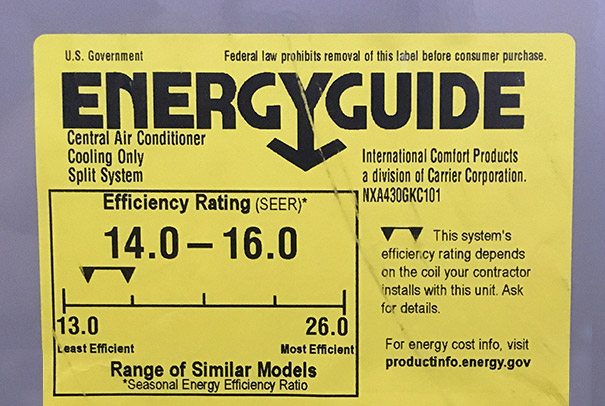
When you begin shopping for a replacement system, you will immediately be presented with a range of efficiency metrics. The most prominent of these is the SEER (or modern SEER2) rating.
For many East Tennessee homeowners, these numbers can feel like abstract corporate jargon. You might wonder: Is it truly worth paying a premium upfront for a high-SEER2 system, or will a baseline model serve your home just as well?
Because Knoxville experiences a dynamic, humid subtropical climate—characterized by hot, sticky summers and moderately cold winters—the "best" SEER2 rating is not a one-size-fits-all answer. It requires a careful calculation of your home's structural layout, your budget, and your long-term comfort goals.
This guide breaks down the science of SEER2 ratings, analyzes how our regional weather affects system performance, and provides a clear path to choosing the ideal efficiency level for your Knoxville property.
1. Demystifying SEER and SEER2: The Science of Efficiency
Before deciding on a rating, it helps to understand what these numbers actually measure. SEER stands for Seasonal Energy Efficiency Ratio. It measures the cooling efficiency of an air conditioner or heat pump over an entire cooling season.
Mathematically, the basic SEER rating is calculated as the ratio of the total cooling output produced by the system (measured in British Thermal Units, or BTUs) to the total electrical energy consumed (measured in Watt-hours) during the same period:
$$SEER = \frac{\text{Total Cooling Output (BTU)}}{\text{Total Electrical Energy Input (Wh)}}$$
In January 2023, the Department of Energy officially transitioned the industry to a new testing standard called SEER2. The old SEER testing protocol assumed a static pressure (resistance to airflow) inside the system of $0.1$ inches of water column ($in.\,H_2O$). However, this low-pressure scenario rarely occurs in real-world residential ductwork, which is often restrictive, dirty, or poorly routed.
The SEER2 standard increases the testing static pressure to $0.5$ $in.\,H_2O$ to mimic a typical home's duct system. Because the blower motor has to work harder under this realistic pressure, SEER2 ratings are generally 4.5% to 5% lower than legacy SEER ratings for the exact same physical equipment.
When comparing systems today, ensure you are looking at SEER2 numbers to get an accurate representation of real-world efficiency.
2. Analyzing Knoxville's Specific Weather Profile
To choose the right rating, you must evaluate the specific atmospheric conditions your HVAC system has to battle. Knoxville's climate presents two distinct challenges: our long cooling season and high relative humidity.
+--------------------------------------------------------------------------+
|                  EAST TENNESSEE SEASONAL TEMPERATURE MATRIX               |
+--------------------------------------------------------------------------+
|  [Spring Transitions] --> High pollen, moderate cooling loads            |
|  [Summer Peaks]       --> Heavy humidity, temperatures consistently 85-95°F |
|  [Autumn Shoulder]    --> Brief rest before heating demand begins        |
|  [Winter Freezes]     --> Below-freezing mountain drafts test heat pumps |
+--------------------------------------------------------------------------+
The Length of the Cooling Season
While homeowners in the deep South run their air conditioners nearly year-round, and homeowners in the Northeast only run theirs for a few peak weeks, Knoxville sits in a transition zone. Our cooling season typically starts in early May and runs steadily through late September, with occasional hot stretches stretching into October.
This moderate-to-long cooling footprint means your system operates under a heavy load for roughly five months of the year. If you have an older, inefficient system during these months, your electric bills will quickly reflect the strain.
The Humidity Factor
In East Tennessee, the summer heat is rarely dry. The Appalachian geography traps moisture, causing high relative humidity levels.
Your air conditioner has two jobs: lowering the sensible temperature (the temperature you read on a thermometer) and removing latent heat (moisture in the air). To remove moisture effectively, an air conditioner needs to run long, steady cycles.
- Single-Stage Systems (Low SEER2): These units run at 100% capacity whenever they turn on. On a warm, humid day, they can lower the indoor temperature so quickly that they satisfy the thermostat and shut off before they have completed a full dehumidification cycle. This results in a cold, damp, and uncomfortable indoor environment.
- Variable-Capacity Systems (High SEER2): These units run at lower, highly efficient speeds for longer periods. This continuous, low-speed operation acts like a giant dehumidifier, stripping moisture out of the air while using a fraction of the electricity of a single-stage system.
Understanding how to keep your AC running efficiently all summer in East TN is key to managing this intense seasonal humidity without driving your energy bills through the roof.
3. The SEER2 Spectrum: Low, Mid, and High Tiers
When planning an upgrade, HVAC equipment generally falls into one of three efficiency tiers:
The Baseline Tier (13.4 to 14.3 SEER2)
This is the minimum federal efficiency standard allowed for new residential installations in the southeastern United States.
- The Setup: These systems typically utilize single-stage compressors and standard PSC (Permanent Split Capacitor) or basic ECM (Electronically Commutated Motor) blower fans.
- Pros: They offer the lowest upfront purchase price.
- Cons: They provide basic temperature control, have limited ability to manage heavy humidity, and yield the highest monthly utility bills.
- Best For: Rental properties, budget-conscious renovations, or homes with very low yearly usage.
The Mid-Tier Comfort Band (15.2 to 17.2 SEER2)
For the average Knoxville homeowner, this tier represents the ideal balance of upfront cost and ongoing savings.
- The Setup: Systems in this range often feature two-stage compressors. They can run at a low, highly efficient capacity (around 65%) on mild days and ramp up to 100% power only when extreme heat hits.
- Pros: Excellent humidity control, quieter operation, and lower monthly utility bills.
- Cons: Slightly higher upfront cost than baseline models.
- Best For: Standard suburban homes, families looking to lower their carbon footprint, and anyone wanting to improve indoor humidity control.
The Premium Tier (18.0 to 22.0+ SEER2)
This represents the peak of modern HVAC engineering.
- The Setup: These systems utilize fully variable-speed inverter compressors. Instead of stepping between two stages, they can run at any speed between 25% and 100% capacity, matching the thermal demands of your home in real-time.
- Pros: Whisper-quiet performance, precise temperature control (within 0.5°F of your setting), superior dehumidification, and the lowest possible operating costs.
- Cons: High initial equipment cost.
- Best For: Long-term homes, properties with complex zoning needs, and homeowners who prioritize maximum efficiency and comfort.
4. Financial ROI: Calculating Your Payback Period
To determine if a high-SEER2 system is worth the investment, you need to look at the payback period—the time it takes for your monthly utility savings to offset the higher upfront cost of the premium equipment.
[ Mid-Tier SEER2 Upgrade ]   ====================> 3 to 5 Year Payback Period
[ Premium Inverter SEER2 ]  ===================================> 7 to 10 Year Payback Period
On average, upgrading from an old, degraded 10 SEER system to a modern 14.3 SEER2 system can lower your cooling costs by roughly 25% to 30%. Moving up to a 16 SEER2 system can yield 35% to 40% savings, while a premium 20+ SEER2 system can cut your cooling bills by 50% or more.
If a mid-tier 16 SEER2 system costs $1,500 more upfront than a baseline 14.3 SEER2 model, but saves you $300 a year on your electric bills, your payback period is five years:
$$\text{Payback Period} = \frac{\text{Upfront Price Difference (\$1,500)}}{\text{Annual Energy Savings (\$300/year)}} = 5 \text{ Years}$$
Because high-quality HVAC systems last 15 to 20 years with proper care, you will enjoy a decade or more of pure monthly savings after your system pays for itself. You can find more helpful advice on managing these expenses in our guide on how to save money on HVAC costs.
5. Beyond the Number: Other Factors That Impact Real-World SEER2
It is important to remember that a SEER2 rating is a laboratory measurement. Just because a box says "18 SEER2" does not guarantee you will get that level of efficiency if your home's infrastructure has hidden issues.
The Role of Professional Installation
An air conditioner is not a plug-and-play appliance like a refrigerator. It is a complex thermodynamic system assembled on-site. If a system is charged with too much or too little refrigerant, or if the airflow across the indoor coil is restricted, even a 20 SEER2 unit will perform like a 12 SEER2 unit, putting excessive strain on the compressor.
Investing in a quality AC installation ensures that your linesets, electrical connections, and refrigerant levels are calibrated to match factory specifications.
The Condition of Your Ductwork
Your ductwork is the delivery path for your heating and cooling system. If your ducts are leaky, uninsulated, or routed through a hot attic, you can lose up to 30% of your system's efficiency to the surrounding structure.
Before upgrading your equipment, have your contractor inspect and seal your ductwork to ensure you get the full efficiency benefit of your new system.
Routine Maintenance Habits
Even the most efficient system will lose its edge if it is neglected. Over time, outdoor condenser coils collect pollen and dirt, and indoor evaporator coils accumulate dust, reducing heat transfer and forcing the system to run longer cycles.
Committing to routine preventive maintenance twice a year is the best way to keep your system clean, maintain its factory efficiency, and avoid unexpected summer breakdowns.
6. Sizing and Sizing Calculations: The Manual J Load Calculation
A common mistake is buying a high-SEER2 system that is improperly sized for the home. If a contractor tries to sell you a system based on your home's square footage alone, seek a second opinion.
To find the correct system size, a professional must perform a detailed Manual J Load Calculation. This calculation analyzes:
- The exact square footage and ceiling height of each room.
- The R-value of your wall, attic, and floor insulation.
- The orientation of your home relative to the sun.
- The number, age, and placement of your windows.
- The local climate data for Knoxville.
An oversized system will short-cycle constantly, failing to dehumidify your home and breaking down prematurely. An undersized system will run continuously without ever reaching your target temperature. Sizing the unit correctly ensures your new SEER2 system can operate exactly as designed.
If your current unit struggles to keep up on hot days, or if you notice uneven temperatures throughout your home, scheduling a professional AC repair diagnostic check can help determine whether your system is failing mechanically or if it was simply improperly sized.
7. Comparative Assessment Matrix
To help streamline your decision-making process, this matrix provides a direct side-by-side comparison of the core operating metrics for each SEER2 tier:
8. Making Your Final Decision: The Knoxville Cheat Sheet
To find the right SEER2 rating for your home, consider your long-term plans:
- Are you planning to move in the next 1 to 3 years? Stick to a baseline 14.3 SEER2 system. You will benefit from the lower upfront installation cost, and you won't live in the home long enough to recoup the premium cost of a high-efficiency system through your monthly utility bills.
- Is this your "forever" home where you plan to stay for 10+ years? Invest in a 16.0 to 18.0 SEER2 two-stage or variable-speed system. The long-term utility savings will easily pay for the upfront upgrade, and you will enjoy superior comfort and humidity control.
- Do you have hot second-floor bedrooms or an unconditioned bonus room? A variable-speed 18.0+ SEER2 system or a ductless mini-split array is often the best choice, allowing you to zone your climate control and maintain comfortable temperatures across all floors.
Partner with Knoxville's Trusted Comfort Professionals
Upgrading your home’s heating and cooling system is a major financial decision. You deserve an HVAC partner who provides honest guidance, transparent pricing, and dependable craftsmanship without high-pressure sales tactics.
At Advanced Heat, AC & Plumbing, we have spent more than 40 years helping families across Knoxville, Blount County, and the surrounding areas design, install, and maintain their comfort systems. As a third-generation, veteran-owned local family business, we combine advanced diagnostic technology with direct, honest service to give you real, long-term peace of mind.
To simplify your home's upkeep, enrolling your new hardware in a comprehensive HVAC service plan ensures your system receives its essential seasonal safety checks, keeping your manufacturer warranties fully intact and your energy bills as low as possible year after year.
📞 Ready to find the perfect, high-efficiency cooling system for your home and budget? Call Advanced Heat, AC & Plumbing today at 865-933-5538 to schedule your professional on-site system consultation!


