


The Impact of Localized "Boil Water Advisories" on Your Home’s Internal Filtration
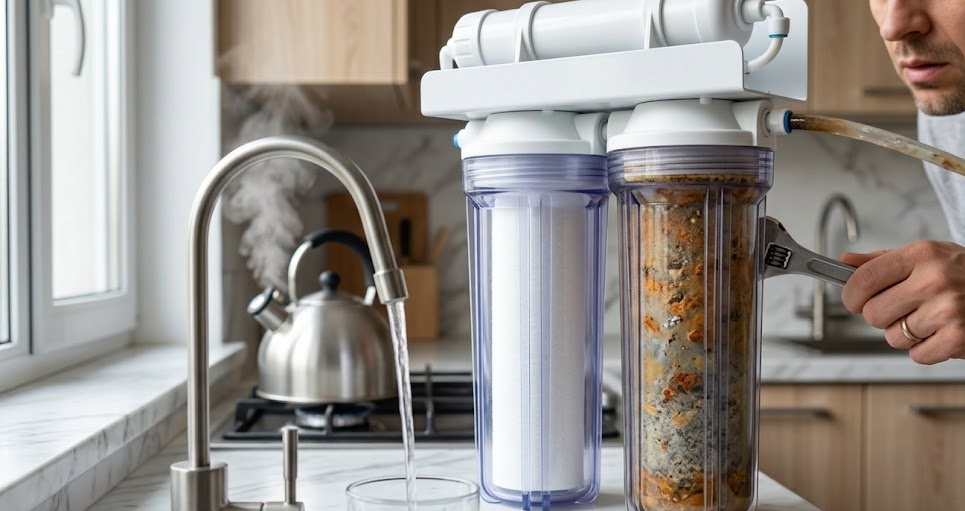
It starts with a text alert or a knock on the door from a neighbor. Whether you are in the heart of Knoxville or tucked away in the foothills of Sevierville, a Boil Water Advisory (BWA) is an immediate disruption to your daily life. Suddenly, the simple act of brushing your teeth or washing a head of lettuce becomes a calculated risk.
But there is a secondary, quieter crisis happening during these advisories that many East Tennessee homeowners overlook: the health of their internal water filtration systems.
While you are busy boiling water on the stove, your refrigerator filters, under-sink Reverse Osmosis (RO) units, and whole-home sediment filters are acting as the front line of defense against contaminated water. These systems are designed to handle "normal" municipal water, not the high-turbidity, pathogen-rich water that triggers an advisory.
At Advanced Heating & Air Conditioning, we don’t just fix pipes—we protect the quality of the life flowing through them. In this article, we’ll explore why BWAs are so hard on your filtration, the science of what’s getting stuck in your cartridges, and the essential steps you must take once the "all-clear" is given to protect your family and your plumbing.
1. Anatomy of a Boil Water Advisory: Why They Happen Here
East Tennessee’s unique geography is a blessing for our views but a challenge for our water infrastructure. Our region sits on Karst topography—a landscape formed from the dissolution of soluble rocks like limestone and dolomite. This creates underground drainage systems with sinkholes and caves.
When we experience the heavy, tropical-style rains common in Maryville or Lenoir City, runoff can bypass natural soil filtration and enter our aquifers or reservoirs directly. This introduces turbidity (cloudiness) and potential pathogens like E. coli or Cryptosporidium.
Common Triggers for a BWA:
- Water Main Breaks: A sudden drop in pressure (below 20 psi) can allow groundwater to seep into the main water line.
- Power Outages at Treatment Plants: If pumps stop, pressure drops, and the risk of backflow increases.
- High Turbidity: Heavy rain "mucks up" the source water, making it difficult for standard chlorination to kill bacteria.
2. The Science of the "Clog": Pathogens and Particulates
When an advisory is issued, it’s usually because the water contains an "unacceptable level" of microorganisms or suspended solids. These aren't just invisible threats; they are physical particles that your filters are desperately trying to catch.
The Biological Load
Most home filters use activated carbon or mechanical membranes. During a BWA, these filters become "biological hotspots." If a bacterium like E. coli gets trapped in a carbon filter, it isn't necessarily killed—it just sits there. Carbon is porous and organic, providing a perfect surface for biofilm to grow.
The Sediment Load
Turbidity is measured in NTUs (Nephelometric Turbidity Units). During a water main break, NTU levels skyrocket. This "muddy" water hits your 5-micron sediment filter and effectively "blinds" it.
The flow rate ($Q$) through your filter can be expressed by Darcy’s Law, which in a simplified plumbing context looks at the pressure drop ($\Delta P$) across the filter medium:
$$Q = \frac{k \cdot A \cdot \Delta P}{\mu \cdot L}$$
Where $k$ is the permeability of the filter. As the "mud" from the BWA fills the pores of the filter, $k$ drops toward zero. This results in the low water pressure many homeowners report immediately following a local water issue.
3. How Different Systems React to an Advisory
Not all filtration is created equal. Depending on what you have installed in your Farragut or Oak Ridge home, the damage may vary.
Refrigerator Filters
These are typically small carbon blocks. They are the most vulnerable. Once they are exposed to contaminated water, they must be replaced. Using a fridge filter during a BWA does not make the water safe to drink, and it virtually guarantees the filter will become a breeding ground for bacteria.
Reverse Osmosis (RO) Units
RO systems are sophisticated. They use a semi-permeable membrane to remove contaminants at a molecular level. However, the pre-filters (sediment and carbon) usually take the brunt of the hit. If you continue to run your RO system during a BWA, you risk "fouling" the expensive RO membrane, which can cost hundreds of dollars to replace.
Whole-Home Sediment Filters
These are your "bodyguards." They protect your water heater and your washing machine hoses from grit. After a BWA, these filters are often chocolate-brown from the silt that entered the lines during the repair of the sewer line or water main.
4. The Hidden Danger: The "Post-Advisory" Flush
When the city tells you the water is safe again, they usually do so after "shocking" the lines with high levels of chlorine ($Cl_2$). While this kills the bacteria, it creates a new problem for your filtration.
High concentrations of chlorine can degrade the structural integrity of carbon filters and rubber seals within your plumbing fixtures. Furthermore, the act of the city flushing the hydrants stirs up years of "scale" and iron deposits from the municipal pipes. This surge of "junk" heads straight for your home.
If you don't flush your home's internal lines correctly, that concentrated "slug" of debris gets trapped in your main stack and secondary branch lines, leading to recurring clogs.
5. Comparison of Filter Vulnerability
6. Your Post-Boil Water Advisory Action Plan
To protect your home in Alcoa or Pigeon Forge, follow this protocol the moment the BWA is lifted:
- Outdoor Flush: Run your outdoor hose bibbs for 10 minutes. This clears the "service line" between the street and your house so you aren't pulling the worst debris into your indoor pipes.
- Cold Water Flush: Run all cold water faucets for 5 minutes. Start at the faucet closest to the water main and move outward.
- Ice Makers: Discard all ice made during the advisory and the first three batches made after the advisory.
- Filter Replacement: This is non-negotiable. If water passed through a carbon or sediment filter during the advisory, that filter is now a compromised asset.
- Water Heater Care: If you used hot water during the BWA, you may have pulled sediment into your tank. This is a great time to schedule a water heater flush to prevent the "rock" buildup we mentioned in our Hard Water Hair article.
7. How Advanced Heating & Air Conditioning Can Help
A Boil Water Advisory is stressful enough without having to worry about the long-term damage to your plumbing. Many homeowners replace their filters but forget to sanitize the housings, leading to lingering odors or "off" tasting water.
Our Specialized BWA Recovery Services Include:
- Whole-Home Sanitization: We can safely disinfect your lines and filter housings following a major contamination event.
- System Upgrades: If you’re tired of BWAs ruining your filters, we install high-capacity systems designed to handle East Tennessee's specific water challenges.
- Leak Detection: Sometimes a BWA is caused by a break on your side of the meter. We use advanced leak detection tools to ensure your water line is secure.
- Expert Advice: Whether it's a furnace repair or a water quality crisis, we bring "Home-First" service to every door.
8. Long-Term Protection: Beyond the Advisory
While BWAs are temporary, the minerals and particulates in East Tennessee water are permanent. If you found that your filters clogged almost instantly during the last advisory, it's a sign that your system is already struggling with our local hard water.
Investing in a robust, multi-stage filtration system doesn't just help during an advisory—it improves your hair health, protects your septic system, and ensures that when you turn on the tap in Clinton or Powell, you’re getting exactly what you expect: clean, clear, safe water.
Final Thought: Don't Let the "All-Clear" Fool You
The city’s "all-clear" means the water at the treatment plant is safe. It doesn't account for the bacteria trapped in your fridge filter or the mud sitting at the bottom of your water heater.
Taking proactive steps after a Boil Water Advisory is the difference between a minor inconvenience and a major plumbing repair. From sewer line replacements to AC installations, Advanced Heating & Air Conditioning is here to keep your East Tennessee home running smoothly.
Contact us today for a comprehensive water quality audit or to refresh your home’s filtration after a local advisory.


