


Outdoor Kitchen Plumbing in Knoxville: What You Need Before You Build
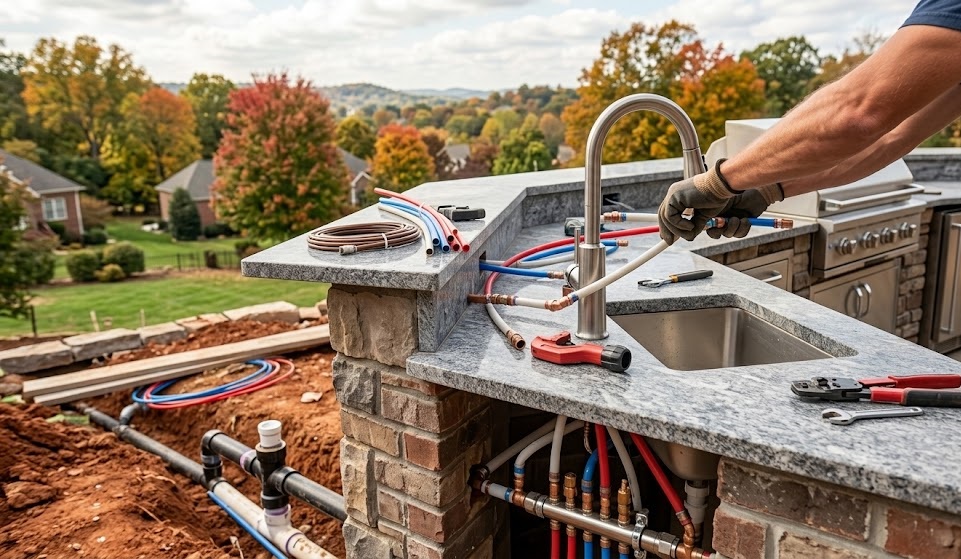
The concept of home entertainment has evolved dramatically. Knoxville homeowners are no longer content with a simple charcoal grill and a plastic patio set on the back deck. Instead, the modern standard for East Tennessee luxury and convenience is a fully realized outdoor living pavilion—complete with stone countertops, built-in stainless steel appliances, smokers, brick pizza ovens, and the crowning jewel of outdoor entertainment: a complete outdoor kitchen.
An outdoor kitchen turns your backyard into a culinary oasis, allowing you to prep, cook, mix drinks, and clean up without constantly walking back and forth to your indoor kitchen. But while it is easy to get swept away picking out premium granite slabs or high-BTU gas burners, the success of your outdoor oasis relies heavily on hidden infrastructure.
Specifically, outdoor kitchen plumbing is the most complex, regulated, and critical part of the entire build.
Bringing pressurized running water outside and disposing of wastewater cleanly requires careful planning, strict adherence to local building codes, and an understanding of East Tennessee’s unique climate. If you cut corners on the plumbing phase, your dream backyard can quickly turn into a nightmare of frozen pipes, foul odors, yard erosion, and structural water damage.
Before you break ground, pour concrete, or order appliances, this comprehensive guide covers everything you must consider about outdoor kitchen plumbing.
1. The Core Infrastructure: Assessing Your Goals
Before a single trench is dug, you must define exactly how you intend to use your outdoor space. The structural layout and financial investment of your plumbing setup depend entirely on the specific fixtures you plan to install.
Cold Water Only vs. Hot and Cold Water Systems
The simplest and most economical outdoor kitchen layout features a cold-water-only supply line. This configuration allows you to rinse vegetables, wash your hands, fill cooking pots, and run a basic bar sink. For many homeowners, this is completely sufficient.
However, if you plan to wash greasy platters, sanitize raw meat prep stations, or integrate a high-end outdoor dishwasher, a single cold-water line will not cut it. You will need a dedicated hot water supply. To achieve this, you must choose between running an insulated hot water line all the way from your indoor water heater or installing a localized, weatherproof tankless point-of-use water heater directly inside your outdoor kitchen cabinetry.
Beyond the Sink: Additional Water-Dependent Fixtures
A modern outdoor kitchen can feature a wide array of water-dependent luxuries:
- Built-in Ice Makers: These require a dedicated, continuous water supply line and, crucially, a reliable drain line to handle melting ice sheets.
- Outdoor Dishwashers: These demand both hot water pressure and a highly regulated drainage path to dispose of soapy graywater.
- Kegerators and Bar Taps: Specialized beverage stations often incorporate glass rinsers, which need specialized water pressure regulators.
Every additional fixture increases the complexity of your under-slab pipe layout. Mapping these out accurately during the initial architectural design phase prevents costly structural revisions later on. Dealing with these hidden connections requires a solid grasp of comprehensive residential plumbing in Knoxville to ensure your home's main systems can handle the auxiliary load.
2. Managing the Supply Lines: Bringing Clean Water Outdoors
Getting fresh, pressurized water from your main home infrastructure out to a freestanding backyard island requires substantial excavation and material choices.
+--------------------------+
|       Main House         |
|  [Interior Main Line]    |
+-------------|------------+
              |
              | (Shut-Off & Drain Valves Inside Basement/Crawlspace)
              v
==================================== (Foundation Wall)
              |
              | <--- Trench Depth: 18 - 24 Inches (Below Frost Line)
              |
              v
+-------------|------------+
|   Outdoor Kitchen Island |
|  [Sink / Ice Maker]      |
+--------------------------+
Trenching Depth and the Knoxville Frost Line
In East Tennessee, winter temperatures routinely drop below freezing. If water sitting inside a buried pipe freezes, it expands with immense force, fracturing the pipe wall. When the ground thaws, you are left with a massive underground leak that can wash away your landscaping and undermine your patio’s foundation.
To prevent this, supply pipes must be buried below the local frost line. In Knoxville, the official frost depth is typically calculated at 12 inches, but best practice for outdoor plumbing lines is to bury them in a trench at least 18 to 24 inches deep. This extra soil barrier ensures that even during prolonged winter cold snaps, the earth surrounding your pipes remains insulated from freezing air.
Material Selection: PEX, Copper, and PVC
When running lines through an underground trench, material selection is vital:
- PEX (Cross-linked Polyethylene): PEX is the undisputed industry gold standard for outdoor utility runs. It is highly flexible, meaning it can be run in long, continuous loops without underground couplings, eliminating potential leak points. Furthermore, PEX has slight elastic properties, meaning if water does freeze inside it, the pipe can expand slightly without cracking.
- Copper: While incredibly durable, copper is expensive, requires meticulous soldering joints that can fail under ground shifts, and is highly vulnerable to bursting if frozen.
- PVC: Schedule 40 PVC is commonly used for irrigation, but it is not approved for pressurized indoor or domestic hot-water supply lines. Stick to PEX or specialized CPVC for your clean water runs.
If you are expanding your water footprint, you must ensure your main supply tap is free of leaks and corrosion before extending it. Resolving any underlying issues via a certified water line repair specialist before closing up your trenches will protect the structural integrity of your new system.
3. The Drainage Dilemma: Where Does the Water Go?
Bringing water to your outdoor kitchen is relatively simple compared to the challenge of disposing of it. Drainage is often where DIY projects stall and run into major code violations. Wastewater from an outdoor sink cannot simply be dumped directly into the grass or channeled into a local storm drain.
Option A: Tying Into Your Home’s Main Drain-Waste-Vent (DWV) System
This is the most secure, sanitary, and code-compliant method available. Under this setup, a sloped PVC drain line runs through the underground trench from the outdoor kitchen sink back into your home's crawlspace or basement, where it ties directly into the primary main waste line.
This requires maintaining a strict downward slope of 1/4 inch per linear foot. If your outdoor kitchen sits lower than the home's main sewer exit point, you will have to install an outdoor sewage ejector pump basin to lift the wastewater up and out to the main line.
Option B: Dry Wells and French Drains (The Graywater Rules)
If your outdoor kitchen is situated far away from the house, digging a long trench with a perfect 1/4-inch slope may be structurally impossible. In some rural areas or specific jurisdictions outside strict city limits, building codes may permit a dry well system for graywater (sink water that does not contain human waste or heavy grease).
A dry well is a deep, gravel-filled subterranean pit covered with geotextile fabric. The sink drains into this pit, and the water slowly filters naturally into the surrounding soil. However, Knoxville city ordinances and Knox County environmental codes are highly restrictive regarding graywater disposal to protect local water tables and rivers from dish soap, food particles, and chemicals.
Always check local regulations before assuming a dry well is legal on your property.
4. The Non-Negotiable Step: Backflow Prevention
When you connect any outdoor accessory—whether it is an irrigation system, a swimming pool filler, or an outdoor kitchen sink—to your home’s clean drinking water supply, you introduce the risk of cross-contamination.
[ Municipal / Well Supply ] ---> [ Home Clean Water ] ---> [ BACKFLOW PREVENTER ] ---> [ Outdoor Kitchen Sink ]
                                                                   |
                                    (Prevents dirty water from ----+
                                     sucking backward into home)
Backflow happens when a sudden drop in municipal water pressure (such as a fire hydrant being opened down the street or a water main break nearby) creates a powerful vacuum or siphoning effect inside your home's pipes. If your outdoor kitchen sink faucet is submerged in dirty water, or if an outdoor appliance fails, that contaminated water can be sucked backward into your home's clean drinking water lines, causing severe illnesses.
To eliminate this hazard, Knoxville plumbing codes mandate the installation of a certified backflow prevention device on the supply line branch leading out to the yard.
This device often takes the form of a Pressure Vacuum Breaker (PVB) or a Reduced Pressure Zone (RPZ) valve assembly. These mechanical valves act as absolute one-way gates: they allow clean water to flow freely out to the yard but open up to vent to the atmosphere the moment a pressure drop occurs, completely severing the connection and blocking any backward siphoning.
Because these systems feature delicate internal springs and seals, installing proper backflow prevention is legally required to be performed and tested by certified professionals to protect public health.
5. Winterization: Protecting Your Investment from Freeze Cycles
In East Tennessee, we enjoy a beautiful, extended outdoor entertainment season that stretches from early spring deep into autumn. But when winter arrives, it brings unpredictable freeze cycles. An outdoor kitchen is entirely exposed to the elements, making a comprehensive winterization design a core requirement of your construction phase.
Designing a Gravity-Drained System
You cannot simply turn off a valve inside the house and assume your outdoor kitchen is safe. Water will remain trapped inside the long, horizontal underground pipes and vertical faucet stubs. When that water freezes, it will split your expensive outdoor fixtures wide open.
To prevent this, your supply lines must be designed to be completely drained of water every autumn. The ideal configuration includes:
- An Indoor Shut-off Valve: Located inside your heated basement or crawlspace, allowing you to cut the water supply to the yard entirely.
- An Indoor Drain Port (Stop-and-Waste Valve): Positioned just past the shut-off valve, allowing you to open a small cap and let gravity pull all the water out of the outdoor pipes and safely drain it into a bucket inside.
- An Outdoor Blow-out Adapter: A specialized plumbing fitting built into the outdoor line that allows you to attach an air compressor. This lets you safely blow high-volume, low-pressure compressed air through the lines to clear out every single drop of residual moisture trapped inside faucet cartridges, ice makers, and water lines.
Understanding these seasonal steps is crucial to avoiding early-spring plumbing disasters. Learning the fundamentals of how to keep your pipes from freezing in winter will protect your primary plumbing infrastructure from cascading failures when temperatures plummet.
6. Planning for Summer Success
Once your system is engineered to handle the winter freezes, you can shift your focus to maximizing your outdoor space when warmer weather arrives. Planning your build with summer utility in mind guarantees your plumbing remains robust during times of peak usage.
+------------------------------------------------------------+
|             OUTDOOR KITCHEN PLUMBING CHECKLIST             |
+------------------------------------------------------------+
| [ ] Main supply line buried 18-24 inches deep              |
| [ ] Certified backflow preventer installed and tested       |
| [ ] Drainage sloped at 1/4-inch per foot to main waste line|
| [ ] Interior shut-off and gravity drain ports installed     |
| [ ] All local permits pulled and code inspections passed   |
+------------------------------------------------------------+
As you coordinate your build timeline, it is highly beneficial to map out seasonal checks. Asking yourself is your outdoor plumbing ready for summer as spring draws to a close ensures that your lines, seals, water filtration systems, and outdoor luxury fixtures are fully primed to deliver pristine, uninterrupted performance for the entire grilling season.
7. Permits, Local Codes, and Professional Execution
It is tempting to look at an outdoor kitchen as a simple weekend DIY project. However, running new utility lines across your property involves substantial structural risks and legal obligations.
Knoxville Permitting Requirements
Within the city limits of Knoxville and throughout Knox County, extending your domestic water supply or adding new drainage infrastructure requires pulling an official residential plumbing permit. This process ensures that your design is safe and code-compliant.
A local code enforcement official will visit your property to inspect your open trenches, verify your burial depths, pressure-test the supply lines, and double-check your backflow prevention setup before you are allowed to backfill the dirt or pour a concrete slab patio over the pipes. If you skip this step, you can face severe fines, be legally forced to tear up your new patio to expose the unpermitted pipes, or face coverage denials from your homeowner's insurance policy if a future leak causes property damage.
The Value of Professional Help
Outdoor kitchen islands are heavy, often constructed with thick steel framing, concrete block, heavy stone veneers, and solid granite countertops. Once that structure is built, accessing the plumbing lines underneath becomes nearly impossible without completely demolishing your expensive stonework.
Partnering with an experienced, licensed team ensures that your outdoor investment is built on a flawless foundation. Professional plumbers use commercial-grade trenching tools, verify precise grade slopes, use exact PEX expansion fittings, and execute proper venting strategies, giving you complete peace of mind.
By treating your outdoor plumbing with the same engineering precision as an indoor luxury remodel, you can build an elite outdoor kitchen pavilion that adds long-term monetary value to your Knoxville home and serves as a worry-free backdrop for family gatherings, game days, and backyard barbecues for decades to come.


