


The Chemistry of Pipe Corrosion: Why certain local water sources eat through copper
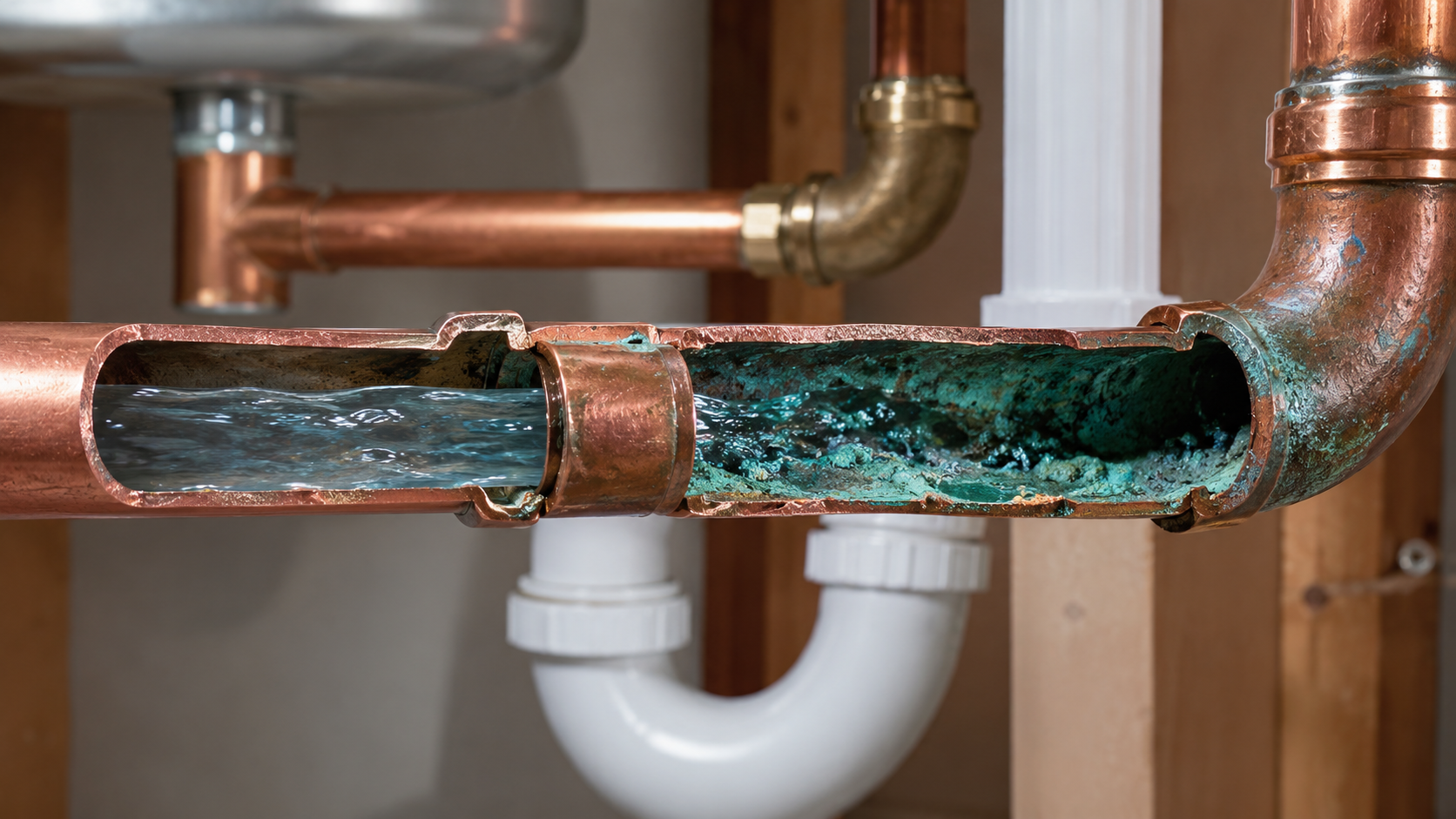
Copper has been trusted in residential plumbing for decades because it is durable, familiar, and long-lasting when conditions are right. But copper is not indestructible. Certain water conditions can slowly attack copper from the inside, creating blue-green stains, metallic taste, pinhole leaks, and pipe failure that seems to come out of nowhere. The frustrating part is that the pipe may look fine on the outside while chemistry is working inside. Understanding why some local water sources are harder on copper helps homeowners protect their plumbing before corrosion turns into water damage.
Why does copper pipe corrode in the first place?
Copper pipe corrodes when water chemistry, oxygen, minerals, temperature, velocity, and installation conditions create reactions at the pipe wall. In simple terms, the water begins interacting with the copper surface in a way that slowly dissolves, pits, or weakens it.
Copper usually forms a thin protective layer inside the pipe over time. When that layer is stable, the pipe can last for many years. When the water is too aggressive, that protective layer can break down or fail to form correctly.
Common chemistry-related drivers include:
- Low pH water
- Low alkalinity
- High dissolved oxygen
- Certain salts or chlorides
- Sulfur compounds
- Water velocity that is too high
- Hard water scale or uneven deposits
- Chemical changes after treatment
For homeowners, the main thing to understand is that copper corrosion is not random. If pinhole leaks, blue-green stains, or metallic taste keep showing up, the water may be telling you something. Your guide on early warning signs of pipe corrosion is a natural next read because the visible clues often appear long before a major leak does.
What does it mean when water is “corrosive”?
Corrosive water is water that tends to dissolve or attack plumbing materials. It is not always dirty water. It may look clear, smell normal, and still be chemically aggressive enough to affect copper over time.
This is why the word “safe” can be confusing. Water can meet drinking-water standards and still behave differently inside a specific home’s plumbing system depending on pipe age, materials, stagnation time, temperature, and local water chemistry.
Corrosivity is usually influenced by a combination of factors:
pH
Lower pH means water is more acidic, and acidic water is often more aggressive toward copper.
Alkalinity
Alkalinity helps buffer pH changes. Low alkalinity can make water less stable.
Dissolved minerals
Minerals can either contribute to protective scale or create deposits that cause uneven corrosion.
Dissolved oxygen
Oxygen helps drive corrosion reactions at metal surfaces.
Treatment chemistry
Disinfection, corrosion inhibitors, and source blending can change how water interacts with household plumbing.
The key point is that corrosivity is about behavior inside the plumbing, not just how the water looks in a glass.
Why does low pH water attack copper?
Low pH water is more acidic. When acidic water contacts copper, it can dissolve small amounts of copper from the pipe wall. Over time, that can thin the pipe, destabilize protective films, and contribute to pinhole leaks.
Homeowners often see low-pH copper corrosion indirectly through:
- Blue-green stains near drains
- Metallic taste
- Turquoise staining around fixtures
- Repeated pinhole leaks
- Green residue near pipe joints
- Premature failure of copper supply lines
This is especially important for homes on private wells because well water chemistry can vary dramatically from property to property. Two homes in the same county can have very different pH, hardness, iron, manganese, sulfur, and mineral profiles.
That is why guessing is risky. If copper corrosion is suspected, the water should be tested before choosing treatment. Your water analysis services in East TN are the correct starting point because the treatment depends on the actual chemistry, not assumptions.
Why can local water sources affect copper differently?
Local water sources differ because surface water, groundwater, and private wells all pick up different chemistry from the environment. Water moving through limestone, shale, clay, sandstone, or soil can absorb minerals and gases that change its behavior. Water treated by a public utility may be stabilized differently than untreated private well water.
In East Tennessee, many homeowners may deal with different water realities depending on whether they use:
- Municipal water
- Private well water
- Shared community systems
- Spring-fed sources
- Water that passes through older service lines
- Water that changes seasonally or after heavy rain
The important point is not that one local source is automatically bad. It is that local variation matters. Some homes may mainly deal with hard water scale. Others may deal with iron, sulfur odor, sediment, or low pH. Others may have public water that is well treated but still interacts with old in-home piping.
Your article on how to test and treat East Tennessee well water fits naturally here because private well owners especially need property-specific testing, not neighborhood guesswork.
How does hard water relate to copper corrosion?
Hard water and corrosive water are not the same thing. This is one of the most important distinctions for homeowners.
Hard water contains higher levels of minerals like calcium and magnesium. Those minerals often create scale on fixtures, water heaters, and appliances. Corrosive water, on the other hand, tends to attack metal surfaces and dissolve plumbing materials.
But the two issues can overlap in complicated ways.
Hard water can create scale
Scale can reduce flow, damage appliances, and create uneven deposits inside plumbing.
Soft or low-mineral water can be more aggressive
Water with too little buffering capacity may be more likely to dissolve metals if other chemistry factors are present.
Deposits can cause localized corrosion
Uneven scale or sediment inside copper pipes can create small areas where corrosion concentrates.
That means homeowners should not assume “hard water” explains every copper problem. White scale points toward mineral buildup. Blue-green staining points more toward copper movement. If both are present, the water chemistry needs a closer look.
For a clear homeowner-friendly explanation of mineral effects, read how hard water impacts your plumbing system.
Why do pinhole leaks happen in copper pipes?
Pinhole leaks happen when corrosion focuses in a tiny area instead of spreading evenly. This is called pitting corrosion. Rather than thinning the entire pipe wall at the same rate, the corrosion creates small pits that deepen until one breaks through.
That is why a pinhole leak can feel shocking. The pipe may look normal from the outside, but one tiny spot has been weakening internally for a long time.
Pitting can be influenced by:
- Water chemistry
- Dissolved oxygen
- High velocity or turbulence
- Flux residue from installation
- Sediment or deposits
- Electrical grounding issues
- Aggressive local water conditions
- Stagnant water sitting in pipe sections
Pinhole leaks are especially frustrating because fixing one leak may not mean the rest of the system is healthy. If the same kind of leak appears in multiple locations, the issue may be systemic.
That is when homeowners should stop thinking only about patching and start thinking about why the pipe is failing.
Why do blue-green stains show up around fixtures?
Blue-green stains are one of the most recognizable signs that copper is moving through the water. The color often comes from dissolved copper that later reacts with air, soap, minerals, or cleaning products around fixtures and drains.
You may see these stains around:
- Sink drains
- Tub drains
- Shower floors
- Faucet bases
- Toilet bowls
- Pipe joints
- Laundry sinks
Blue-green staining does not automatically prove the entire plumbing system is failing, but it is a warning sign. It means copper is entering the water somewhere. That could be from plumbing corrosion, a local section of pipe, a water heater connection, or a specific water chemistry issue.
The mistake is cleaning the stain again and again without asking why it keeps forming. If copper staining returns quickly after cleaning, water testing and plumbing evaluation are smarter than stronger cleaners.
How does water velocity damage copper?
Copper pipes can also suffer when water moves too fast. High velocity can disturb protective films inside the pipe and create turbulence near elbows, fittings, and changes in direction. Over time, this can lead to erosion-corrosion.
This type of damage is more likely where water is forced through:
- Undersized pipes
- Tight bends
- Poorly planned fittings
- Recirculation lines
- High-pressure systems
- Areas near valves or restrictions
Homeowners usually do not see velocity inside the pipe. They see symptoms later, such as leaks near fittings, repeated failures at certain elbows, or noisy flow.
This is one reason plumbing design matters. A system can have decent water chemistry and still suffer if water speed, pressure, or installation quality is wrong. The chemistry is important, but the hydraulics matter too.
If pressure or supply-side issues are already showing up, water line repair for leaks and pressure problems is a relevant next step because corrosion often becomes visible only after the line is already compromised.
What role does chlorine or disinfectant chemistry play?
Public water systems disinfect water to protect public health. That is essential. But disinfectant chemistry can also influence how water interacts with plumbing materials. Chlorine residuals, chloramine, pH adjustment, alkalinity, and corrosion inhibitors all matter in the balance between safe water and pipe protection.
This does not mean disinfected municipal water is “bad.” It means water chemistry is carefully managed for both safety and distribution system stability. Utilities monitor and adjust water quality to reduce public-health risks, including lead and copper corrosion concerns.
Inside a home, however, conditions can still vary. Water may sit in pipes overnight. It may pass through old copper, brass, solder, or mixed-metal fittings. It may be heated. It may move through sections with scale or sediment.
That is why corrosion control is not only a utility issue. The final stretch of plumbing inside the home matters too. A public system can be well managed, while one older house still has pipe corrosion symptoms because of its private plumbing condition.
Why do some homes have copper problems while neighbors do not?
This is one of the most common and frustrating questions. Two homes can sit on the same street and have very different corrosion outcomes.
Possible reasons include:
- Different pipe ages
- Different copper tube types
- Different installation quality
- Different soldering or flux residue
- Different water use patterns
- Different water heaters
- Different pressure conditions
- Different stagnation time
- Different filtration or softening equipment
- Different sections of private service line
A home that sits empty during the day may experience more water stagnation. A home with a recirculation system may experience more water movement and heat exposure. A home with old pipes may react differently than a recently repiped home.
That is why neighborhood advice is limited. Your neighbor’s water may be chemically similar, but your plumbing system may not be. Copper corrosion is the result of both water and pipe conditions.
How do water heaters affect copper corrosion?
Water heaters can influence corrosion because heat changes water chemistry and reaction rates. Hot water can be more aggressive than cold water under certain conditions, and the water heater can collect sediment, minerals, and corrosion byproducts that affect the system.
Potential water-heater connections include:
- Elevated water temperature accelerating reactions
- Sediment buildup affecting flow and chemistry
- Dissimilar metal connections creating galvanic concerns
- Recirculation systems keeping hot water moving longer
- Pressure issues stressing fixtures and pipes
This does not mean the water heater is always the cause. It means hot-water side corrosion should be evaluated differently from cold-water side symptoms. If blue-green stains or leaks mostly show up on hot-water lines, that pattern matters.
Your content on regular water heater maintenance fits naturally here because a neglected water heater can contribute to plumbing stress beyond just inconsistent hot water.
What is galvanic corrosion, and why does it matter?
Galvanic corrosion happens when different metals are connected in a way that allows one metal to corrode faster than it normally would. Plumbing systems often include copper, brass, steel, galvanized materials, stainless connectors, and other metals. If transitions are not handled correctly, corrosion risk can increase.
This can happen near:
- Water heater connections
- Old galvanized-to-copper transitions
- Mixed-metal fittings
- Improperly installed repairs
- Underground connections
- Appliance supply connections
Galvanic corrosion is one reason a copper pipe problem may be localized near a specific connection instead of spread evenly through the whole home. The water chemistry matters, but the materials touching each other matter too.
This is also why DIY repairs can create long-term problems. A fitting that stops a leak today may create a corrosion point later if the material transition is wrong.
Can filtration or treatment stop copper corrosion?
Sometimes, but the treatment must match the cause. This is where many homeowners make expensive mistakes. A filter chosen for taste and odor may not correct low pH. A softener may help scale but may not solve copper corrosion. A neutralizer may help acidic water but may not address sediment or bacteria.
Treatment options may include:
- pH correction
- Acid neutralizers
- Corrosion control treatment
- Sediment filtration
- Whole-home water treatment
- Water softening when hardness is the problem
- Specific filtration based on test results
The right solution depends on the test results. That is why the first step is always diagnosis. If the problem is low pH, treating for hardness alone will not solve it. If the problem is high velocity or poor installation, water treatment alone may not solve it either.
Your guide on improving water quality with filtration and treatment systems is the right internal link here because water treatment should be selected by evidence, not by guessing.
When should old copper pipes be replaced instead of treated?
Treatment can help when water chemistry is the primary issue and the pipe is still structurally sound. But if copper pipes are already failing repeatedly, heavily pitted, or leaking in multiple locations, replacement may be the more honest long-term answer.
Replacement becomes more likely when:
- Multiple pinhole leaks have appeared
- Pipes are decades old and visibly worn
- Water quality treatment will not reverse existing damage
- Repairs keep moving from one spot to another
- Renovation work already opens walls or ceilings
- Corrosion is widespread rather than isolated
This is where homeowners need to separate prevention from rescue. Water treatment may slow future corrosion, but it cannot rebuild a pipe wall that has already thinned or pitted. If the copper is already compromised, pipe replacement may be the safer investment.
For homeowners at that decision point, when to repair or replace old plumbing pipes is the best next read because repeated repairs can become more expensive than a planned upgrade.
How can homeowners spot corrosion before a leak happens?
The best time to catch copper corrosion is before water starts dripping through a ceiling or wall. Fortunately, corrosion usually gives clues if homeowners know what to look for.
Watch for:
- Blue-green stains around fixtures
- Metallic taste
- Green residue on exposed copper
- Pinhole leaks
- Sudden drops in water pressure
- Damp drywall or cabinet bottoms
- Discolored water after stagnation
- Repeated leaks at fittings
- Corrosion near water heater connections
One clue by itself may not tell the whole story. Several clues together deserve attention.
For example, blue-green stains plus metallic taste plus repeated leaks point toward a different level of concern than one isolated stain. If moisture is already suspected but not visible, early signs your home has hidden plumbing leaks can help homeowners recognize the damage pattern before it spreads.
What should a professional evaluation include?
A professional evaluation should look at both water chemistry and plumbing condition. Looking at one without the other can miss the real cause.
A strong evaluation may include:
- Water pH testing
- Hardness and alkalinity checks
- Copper and metals testing where appropriate
- Visual inspection of exposed copper
- Review of leak history
- Water pressure testing
- Water heater inspection
- Evaluation of pipe age and materials
- Review of filtration, softening, or treatment equipment
- Leak detection when moisture is suspected
The goal is to answer three questions:
- Is the water chemically aggressive?
- Is the plumbing already damaged?
- Is the problem isolated or system-wide?
That third question matters most for cost. An isolated bad fitting may be a simple repair. A chemistry-driven pattern across the home requires a larger plan.
Why is waiting so expensive with copper corrosion?
Waiting is expensive because corrosion works quietly until the leak appears. By the time water is visible, the pipe may have been weakening for months or years. The repair bill may also include drywall, flooring, cabinets, ceilings, and mold prevention if the leak stayed hidden.
The cost of waiting can include:
- Emergency leak repair
- Water damage restoration
- Repeated pipe patches
- Damaged flooring or drywall
- Cabinet replacement
- Higher water bills
- Water treatment installed later than ideal
- Full pipe replacement after many smaller repairs
Copper corrosion is exactly the kind of problem that punishes delay. A stain, taste change, or pinhole leak is not just a nuisance. It is data. The home is giving evidence that the water and pipe system need attention.
Your article on the dangers of ignoring plumbing leaks fits naturally here because corrosion-related leaks can create the same hidden damage pattern as any other slow plumbing failure.
What should homeowners do if they suspect local water is damaging copper?
The best response is not panic and not guesswork. It is a step-by-step process that confirms the issue and separates chemistry, pipe age, pressure, and installation problems.
Step-by-step action plan
- Take photos of stains, leaks, or residue.
- Note whether symptoms appear on hot water, cold water, or both.
- Check whether neighbors have similar issues, but do not rely on that alone.
- Schedule water testing for pH, hardness, alkalinity, and metals where appropriate.
- Have exposed copper and water heater connections inspected.
- Test water pressure if leaks or fixture wear are recurring.
- Choose treatment or repair based on findings.
- Consider pipe replacement if failures are widespread.
This process avoids the two biggest mistakes: treating the wrong water problem and patching pipes that are already failing system-wide.
FAQs about copper pipe corrosion and local water chemistry
Does copper pipe corrosion always mean the water is unsafe?
Not always. It means copper is interacting with the water or plumbing conditions. Testing is the right way to understand whether there are water-quality concerns.
What does blue-green staining mean?
It often means copper is dissolving into the water and leaving residue around fixtures or drains.
Can hard water eat through copper pipes?
Hard water usually creates scale, while corrosive water attacks metal. However, deposits and water chemistry can interact in ways that still contribute to localized problems.
Is acidic well water bad for copper?
It can be. Low-pH water is one of the strongest warning signs for copper corrosion risk.
Can a water filter fix copper corrosion?
Only if it is the right treatment for the actual cause. A taste-and-odor filter may not correct pH or corrosion chemistry.
Should I replace copper pipes after one pinhole leak?
Not always, but one pinhole leak should prompt a closer look. Multiple pinhole leaks are a much stronger sign of a system-wide problem.
Can public water cause copper corrosion?
Public systems monitor and treat for corrosion control, but in-home plumbing conditions still matter. Old pipes, stagnation, temperature, and pressure can influence what happens inside the house.
What is the best first step?
Start with water analysis and plumbing inspection. The chemistry and pipe condition need to be evaluated together.
Stop treating copper corrosion like a mystery leak
Copper pipe corrosion is chemistry, not bad luck. When the water’s pH, alkalinity, oxygen, mineral content, velocity, and treatment history interact with copper in the wrong way, the pipe can slowly lose its protection from the inside. Local water sources matter because well water, municipal water, groundwater, and home plumbing conditions can all behave differently.
Here are the biggest takeaways:
- Copper corrosion usually starts with water chemistry and pipe conditions working together
- Blue-green stains, metallic taste, and pinhole leaks should never be ignored
- Hard water, acidic water, low alkalinity, velocity, and mixed metals can all influence corrosion risk
- Testing is the only reliable way to choose the right treatment or repair plan
If your home is showing signs of copper corrosion, the smartest next step is to stop guessing. Start with professional plumbing services in Knoxville and East Tennessee so your water chemistry, pipe condition, and repair options can be evaluated before the next leak makes the decision for you.


